IT 590 Unit 5


T590-4: Evaluate ethical issues in information technology case studies.

Purpose

case study is used to help you participate in real-life analysis and communication. A case study is a learning tool that provides you with the nature and scope of the problem and prepares you to analyze and discuss the implications of the study. In this assignment, you will learn how to write a case study analysis for a case study related to ethical issues of new and emerging technologies.


Wheeler, J. (2018). Mining the first 100 days: Human and data ethics in Twitter research. Journal of Librarianship & Scholarly Communications, Special Issue, 6, 1–23.

  • Write a case study analysis explaining the ethical issues related to the study. (Case Study Attached) Your case study analysis should be a minimum of 1500 words, which is around 6 double-spaced pages, written in an appropriate format. References and in-text citations should be in APA format.
  • Follow the “How to Write a Case Study Analysis” provided in the link above. Include the following:
  • Use  SWOTT (strengths, weaknesses, opportunities, threats, and technology) tool to perform your analysis and show the diagram or provide a complete explanation of how the tool was used in your analysis.

  • Identification of major issues
  • Identification of alternative courses of action
  • Recommended course of action
  • Justification for course of action, citing sources to support your recommendation.
  1. Additional Guidelines:
    1. Only provide a brief paraphrase and summary of the case to provide context. Use the case study to answer key questions and identify key issues. Base analysis and recommendations on course material and relevant outside research.
    2. Begin with a holistic statement that will be supported with detail in following parts of your analysis.
    3. Do not assume the reader knows anything about your case. Provide detail required to help the reader understand.

Assignment Requirements

  1. Your paper should be a minimum of 1500 words, which is around 6 double-spaced pages.
  2. Use Times New Roman 12 pt font.
  3. Use APA formatting for paper, citations, and references.
  4. Be sure to cite your sources and provide the appropriate references.

Needs help with similar assignment?

We are available 24x7 to deliver the best services and assignment ready within 3-4 hours? Order a custom-written, plagiarism-free paper

Get Answer Over WhatsApp Order Paper Now

IT590 Unit 6

Purpose

The purpose of this assignment is to allow you to make an ethical decision and to evaluate the risk impact of that ethical decision with regard to a specific information technology.

Assignment Instructions

For this assignment, you will use several models and sets of questions defined in your textbook reading to analyze an ethical information technology scenario.

Case Study Link: https://www.scu.edu/ethics/focus-areas/internet-ethics/resources/ai-death-and-mourning/


Perform your analysis using each of the methods below:

Part 1: Answer the following questions about your chosen scenario:

  1. Does it preserve human dignity? Does it enhance human dignity?
  2. Does it preserve the autonomy of the human?
  3. Is the data collection and processing necessary and proportional?
  4. Does it uphold the common good?

Part 2: For your particular technology, complete the following from the perspective of the designer or developer.

We want to

So that we can

Which will deliver the following benefits

To the following stakeholders

Part 3: Consider the environment of your scenario from four perspectives:

  1. Social (in the context of society and the organization culture)
  2. Technical (Consider the technical architecture and design.)
  3. Legal (Consider the legal issues that could affect the scenario.)
  4. Moral (Consider the ethical and moral factors of the scenario.)

In completing the moral perspective, rely on the utility versus invasiveness matrix and discuss it in these terms:

High utility — low invasiveness (ethical risk far outweighed by the benefit to individual or society)

High utility — high invasiveness (requires additional controls to reduce invasiveness)

Low utility — high invasiveness (needs invasiveness reduced and/or utility increased)

Low utility — low invasiveness (no value is being added to society or individuals)

After completing this systematic ethical assessment and risk impact, provide a synthesis of what you have learned and write a recommendation as to whether use of this technology should continue. Justify your recommendation through logical argument and supporting sources. You should also provide related examples that help support your recommendation. 

Assignment Requirements

  1. The paper should be 3–4 double-spaced pages.
  2. Use Times New Roman 12 pt font.
  3. Use APA formatting for paper, citations, and references.
  4. Be sure to cite your sources and provide the appropriate references.

Needs help with similar assignment?

We are available 24x7 to deliver the best services and assignment ready within 3-4 hours? Order a custom-written, plagiarism-free paper

Get Answer Over WhatsApp Order Paper Now

IT591 Unit 5


Purpose

It is important to understand how compliance and penalties differ across statutes, regulations, and contractual obligations, as this will affect decisions that need to be made in security controls that an organization will need to implement and will also have an impact on performing an accurate risk assessment. In this assignment, you will provide a specific example of a statute, a regulation, and a contractual agreement for an industry of their choice. You will discuss the differences in the origin of each, the compliance requirements of each, and the penalties for each within that specific industry.

Assignment Instructions

  1. Select an industry of your choice (retail, education, military, healthcare, financial, government) and briefly describe that industry in today’s world and discuss any changes occurring within the industry that are relevant for security.
  2. For that industry, identify one specific relevant statute, one relevant regulation, and one relevant contractual obligation that might exist.
  3. Create a header for Statute, Regulation, and Contractual Obligation. For each, describe the origin of the statute, regulation, or need for contract. Discuss the compliance requirements for the statute, the regulation, and the contract. Discuss the penalties that exist for the lack of compliance under each.
  4. Describe the statute, regulation, and contractual obligation in terms of how it might affect a security risk assessment for the organization. 

Assignment Requirements

  • 4–5 pages of content (exclusive of cover sheet and references page), using Times New Roman font style, 12 point, double-spaced, using correct APA formatting, and include a cover sheet, table of contents, abstract, and reference page(s)
  • At least 1 credible source cited and referenced
  • No spelling errors
  • No grammar errors
  • No APA errors

Needs help with similar assignment?

We are available 24x7 to deliver the best services and assignment ready within 3-4 hours? Order a custom-written, plagiarism-free paper

Get Answer Over WhatsApp Order Paper Now

Week 8 Discussion: Methods for Developing Teams and Managers

INSTRUCTIONS- Discuss the methods used in your organization to develop project and program teams and project, program, or portfolio managers. 

BELOW ARE MY TWO PREVIOUS JOBS WITH SOME DESCRIPTIONS OF EACH!! I ALSO PUT AN EXAMPLE IN  THE UPLOAD FILE OF A CLASSMATES DISCUSSION FOR EXAMPLE,FYI IT DOES NOT HAVE TO BE THAT LONG!!!!

 I HAVE 2 JOBS I AM A TECH SUPERVISOR AT SPECTRUM, AND A DELIVERY DRIVER FOR KROGER!!

 TECH SUPERVISOR-solving more complex problems that are beyond a technician’s expertise, reading system schematics, follow specifications to implement and maintain system components; provide training and oversight of field technicians; monitor, inspect and support systems operation

KROGER DELIVERY DRIVER –  

Serve as brand ambassador, providing excellent customer service while delivering customer orders to the home

Drive a company delivery vehicle showing safe, efficient driving behavior and following Kroger’s driving standards

Needs help with similar assignment?

We are available 24x7 to deliver the best services and assignment ready within 3-4 hours? Order a custom-written, plagiarism-free paper

Get Answer Over WhatsApp Order Paper Now

Computer Science week 6 assignment


Memo

To: <Project Manager’s Name Here>

From: <Your Name Here>

CC:  <Anyone else who gets a copy here>

Dear <PM’s Name Here>. 

<Describe your process flow for this project that you created last week and submitted. Cut and paste a screen shot that is readable for easy reference below (1-3 pages)>

Needs help with similar assignment?

We are available 24x7 to deliver the best services and assignment ready within 3-4 hours? Order a custom-written, plagiarism-free paper

Get Answer Over WhatsApp Order Paper Now

H3 – 14


Ethics and Information Management

Using Campbellsville University library and/or other sources, read at least four (4) academically reviewed articles on the ethical issues that may arise in information management. Please note that Wikipedia articles will not be accepted for this discussion.

1.    Write a comparative analysis of the articles noting the similarities and differences.

2.    Compare the information in those articles to the materials in Chapter 14 of your textbook. Does the premise of those articles support the overall theme of the materials in Chapter 14 of your textbook? Why or why not?

3.    Discuss what you learned from those articles. In your discussion, give example(s) of your organization handles ethic concerns as they relate to information management.

Needs help with similar assignment?

We are available 24x7 to deliver the best services and assignment ready within 3-4 hours? Order a custom-written, plagiarism-free paper

Get Answer Over WhatsApp Order Paper Now

What protocols comprise TLS

  • 6.2 What protocols comprise TLS?
  • 6.3 What is the difference between a TLS connection and a TLS session?
  • 6.4 List and briefly define the parameters that define a TLS session state.
  • 6.5 List and briefly define the parameters that define a TLS session connection.
  • 6.6 What services are provided by the TLS Record Protocol?
  • 6.7 What steps are involved in the TLS Record Protocol transmission?
  • 6.8 What is the purpose of HTTPS?
  • 6.9 For what applications is SSH useful?
  • 6.10 List and briefly define the SSH protocols.

Needs help with similar assignment?

We are available 24x7 to deliver the best services and assignment ready within 3-4 hours? Order a custom-written, plagiarism-free paper

Get Answer Over WhatsApp Order Paper Now

DFA NFA – Theory of Computation

Hello, Can anyone please help me with the solutions to the set of questions. I want it digitally created with turnitin report. Even the diagrams should be created digitally.

Needs help with similar assignment?

We are available 24x7 to deliver the best services and assignment ready within 3-4 hours? Order a custom-written, plagiarism-free paper

Get Answer Over WhatsApp Order Paper Now

CMPEN LAB

This question uses the MARS MIPS simulator. The goal is to write a loop in assembly that converts hexadecimal numbers into UTF-8 binary sequences. The details are as follows:

You should copy-and-paste the file lab2.txt [which is pasted below] into the MARS editor, and then save the file as your own, for editing. Spend some time trying to see what it does. The parts that need to be changed in main are between the comment lines Your part starts here and Your part ends here. You should also add more lines to the register assignment table, to describe what you did. Additional comments will probably be helpful. There are also two character strings that need to be changed, to put your names in the output.

Here are the Mars Messages and Run I/O panels, after assembling and running the starter program:

Assemble: assembling /…/lab2.asm

Assemble: operation completed successfully.

Go: running lab2.asm

Go: execution completed successfully.

0 0x00000000 0x00000003 00000000000000000000000000000000 00000000000000000000000000000011

1 0x00000024 0x00000003 00000000000000000000000000100100 00000000000000000000000000000011

2 0x0000007e 0x00000003 00000000000000000000000001111110 00000000000000000000000000000011

3 0x0000007f 0x00000003 00000000000000000000000001111111 00000000000000000000000000000011

4 0x00000080 0x00000003 00000000000000000000000010000000 00000000000000000000000000000011

5 0x000000a2 0x00000003 00000000000000000000000010100010 00000000000000000000000000000011

6 0x00000627 0x00000003 00000000000000000000011000100111 00000000000000000000000000000011

7 0x000007ff 0x00000003 00000000000000000000011111111111 00000000000000000000000000000011

8 0x00000800 0x00000003 00000000000000000000100000000000 00000000000000000000000000000011

9 0x000020ac 0x00000003 00000000000000000010000010101100 00000000000000000000000000000011

10 0x00002233 0x00000003 00000000000000000010001000110011 00000000000000000000000000000011

11 0x0000ffff 0x00000003 00000000000000001111111111111111 00000000000000000000000000000011

12 0x00010000 0x00000003 00000000000000010000000000000000 00000000000000000000000000000011

13 0x00010348 0x00000003 00000000000000010000001101001000 00000000000000000000000000000011

14 0x00022e13 0x00000003 00000000000000100010111000010011 00000000000000000000000000000011

15 0x0010ffff 0x00000003 00000000000100001111111111111111 00000000000000000000000000000011

16 0x89abcdef 0x00000003 10001001101010111100110111101111 00000000000000000000000000000011

All done!

— program is finished running –

The idea behind UTF-8 is to augment a character code with some additional bits to protect against certain kinds of communication failures. Here is the standard diagram:
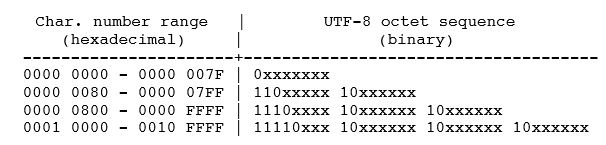
Char. number range (hexadecimal) UTF-8 octet sequence (binary) 0000 0000 0000 007F |0xxxxxxx 0000 0080 0000 07FF | 110xxxxx 10xxxxxx 0000 0800 0000 FFFF 1110xxxx 10xxxxxx 10xxxxxx 0001 0000 0010 FFFF | 11110xxx 10xxxxxx 10xxxxxx 10xxxxxx

The term “octet” means “8 bits”, which everyone now thinks of as one byte. There were once computers whose byte size was not 8 bits, but they are all gone now.
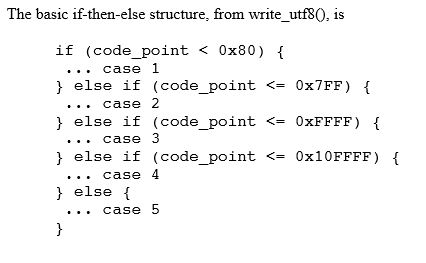
In the starter version provided, we used the variable j instead of code_point. Each case should compute n from j.

It’s going to be a lot easier if you sketch the solution in C, and then rewrite it into MIPS assembler, inserting the C version as a comment. Start with the if-then-else structure, and test that with some bogus values for n. Then, write each of the five cases separately; two of these are trivial, and the other three have a lot of features in common.

The MIPS assembly code is slightly easier to write if all the tests are < instead of a mixture of < and <= . Also, treat the registers as if they contain unsigned integers (when using a numeric instruction) or simple bit strings (when using logical and shift instructions).

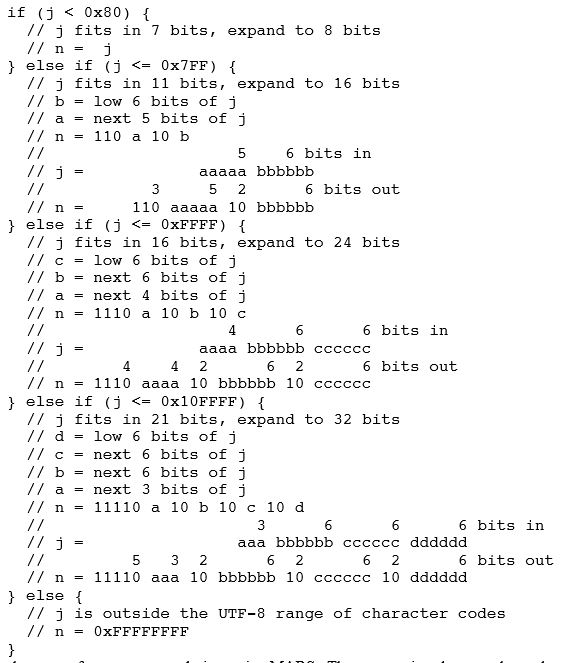
In case 1, j fits in 7 bits, and it is expanded to 8 bits with a leading 0 bit, which yields the same value. In case 5, it’s an error, so n is -1 or 0xFFFFFFFF; that’s not the proper treatment of errors according to UTF-8, but it’s certainly easier.

The following comments describe how the bits of j are to be rearranged to form the bits of n.
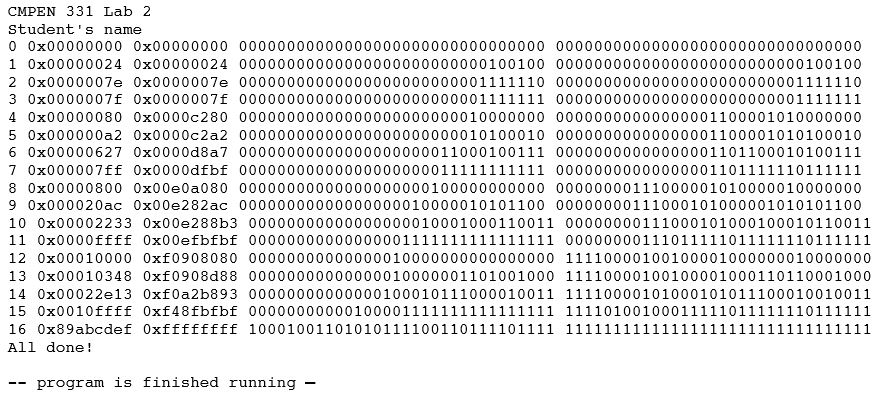
Here is the output from a correct solution, using MARS:
You are finished when you are satisfied that your program works and runs efficiently.

BELOW IS THE BASE CODE REFERENCED AT THE BEGINNING (lab2.txt):

# CMPEN 331, Lab 2

# – – – – – – – – – – – – – – – – – – – – – – – – – – – – – – – – – – – – – – – –

# switch to the Data segment
.data
# global data is defined here

# Don’t forget the backslash-n (newline character)
Homework:
.asciiz “CMPEN 331 Homework 2\n”
Name_1:
.asciiz “First Person’s name\n”
Name_2:
.asciiz “Second Person’s name\n”

# – – – – – – – – – – – – – – – – – – – – – – – – – – – – – – – – – – – – – – – –

# switch to the Text segment
.text
# the program is defined here

.globl main
main:
# Whose program is this?
la $a0, Homework
jal Print_string
la $a0, Name_1
jal Print_string
la $a0, Name_2
jal Print_string

# int i, j = 2, n = 3;
# for (i = 0; i <= 16; i++)
# {
# … j = testcase[i]
# … calculate n from j
# … print i, j and n
# }

# register assignments
# $s0 i
# $s1 j = testcase[i]
# $s2 n
# $t0 address of testcase[i]
# $a0 argument to Print_integer, Print_string, etc.
# add to this list if you use any other registers

# initialization
li $s1, 2 # j = 2
li $s2, 3 # n = 3

# for (i = 0; i <= 16; i++)
li $s0, 0 # i = 0
la $t0, testcase # address of testcase[i]
bgt $s0, 16, bottom
top:
lw $s1, 0($t0) # j = testcase[i]
# calculate n from j
# Your part starts here
# Your part ends here

# print i, j and n
move $a0, $s0 # i
jal Print_integer
la $a0, sp # space
jal Print_string
move $a0, $s1 # j
jal Print_hex
la $a0, sp # space
jal Print_string
move $a0, $s2 # n
jal Print_hex
la $a0, sp # space
jal Print_string
move $a0, $s1 # j
jal Print_bin
la $a0, sp # space
jal Print_string
move $a0, $s2 # n
jal Print_bin
la $a0, nl # newline
jal Print_string

# for (i = 0; i <= 16; i++)
addi $s0, $s0, 1 # i++
addi $t0, $t0, 4 # address of testcase[i]
ble $s0, 16, top # i <= 16
bottom:

la $a0, done # mark the end of the program
jal Print_string

jal Exit0 # end the program, default return status

# – – – – – – – – – – – – – – – – – – – – – – – – – – – – – – – – – – – – – – – –

.data
# global data is defined here
sp:
.asciiz ” ” # space
nl:
.asciiz “\n” # newline
done:
.asciiz “All done!\n”

testcase:
# UTF-8 representation is one byte
.word 0x0000 # nul # Basic Latin, 0000 – 007F
.word 0x0024 # $ (dollar sign)
.word 0x007E # ~ (tilde)
.word 0x007F # del

# UTF-8 representation is two bytes
.word 0x0080 # pad # Latin-1 Supplement, 0080 – 00FF
.word 0x00A2 # cent sign
.word 0x0627 # Arabic letter alef
.word 0x07FF # unassigned

# UTF-8 representation is three bytes
.word 0x0800
.word 0x20AC # Euro sign
.word 0x2233 # anticlockwise contour integral sign
.word 0xFFFF

# UTF-8 representation is four bytes
.word 0x10000
.word 0x10348 # Hwair, see http://en.wikipedia.org/wiki/Hwair
.word 0x22E13 # randomly-chosen character
.word 0x10FFFF

.word 0x89ABCDEF # randomly chosen bogus value

# – – – – – – – – – – – – – – – – – – – – – – – – – – – – – – – – – – – – – – – –

# Wrapper functions around some of the system calls
# See P&H COD, Fig. A.9.1, for the complete list.

.text

.globl Print_integer
Print_integer: # print the integer in register $a0 (decimal)
li $v0, 1
syscall
jr $ra

.globl Print_string
Print_string: # print the string whose starting address is in register $a0
li $v0, 4
syscall
jr $ra

.globl Exit
Exit: # end the program, no explicit return status
li $v0, 10
syscall
jr $ra # this instruction is never executed

.globl Exit0
Exit0: # end the program, default return status
li $a0, 0 # return status 0
li $v0, 17
syscall
jr $ra # this instruction is never executed

.globl Exit2
Exit2: # end the program, with return status from register $a0
li $v0, 17
syscall
jr $ra # this instruction is never executed

# The following syscalls work on MARS, but not on QtSPIM

.globl Print_hex
Print_hex: # print the integer in register $a0 (hexadecimal)
li $v0, 34
syscall
jr $ra

.globl Print_bin
Print_bin: # print the integer in register $a0 (binary)
li $v0, 35
syscall
jr $ra

# – – – – – – – – – – – – – – – – – – – – – – – – – – – – – – – – – – – – – – – –

Needs help with similar assignment?

We are available 24x7 to deliver the best services and assignment ready within 3-4 hours? Order a custom-written, plagiarism-free paper

Get Answer Over WhatsApp Order Paper Now

Risk and costs of compromised data integrity breaches

In 250 words or more, discuss the risk and costs of compromised data integrity breaches. Focus on integrity not confidentiality. Look at military, education, science, medicine, finance, utilities, municipalities, etc. 

Needs help with similar assignment?

We are available 24x7 to deliver the best services and assignment ready within 3-4 hours? Order a custom-written, plagiarism-free paper

Get Answer Over WhatsApp Order Paper Now